
Making medication schedules visible
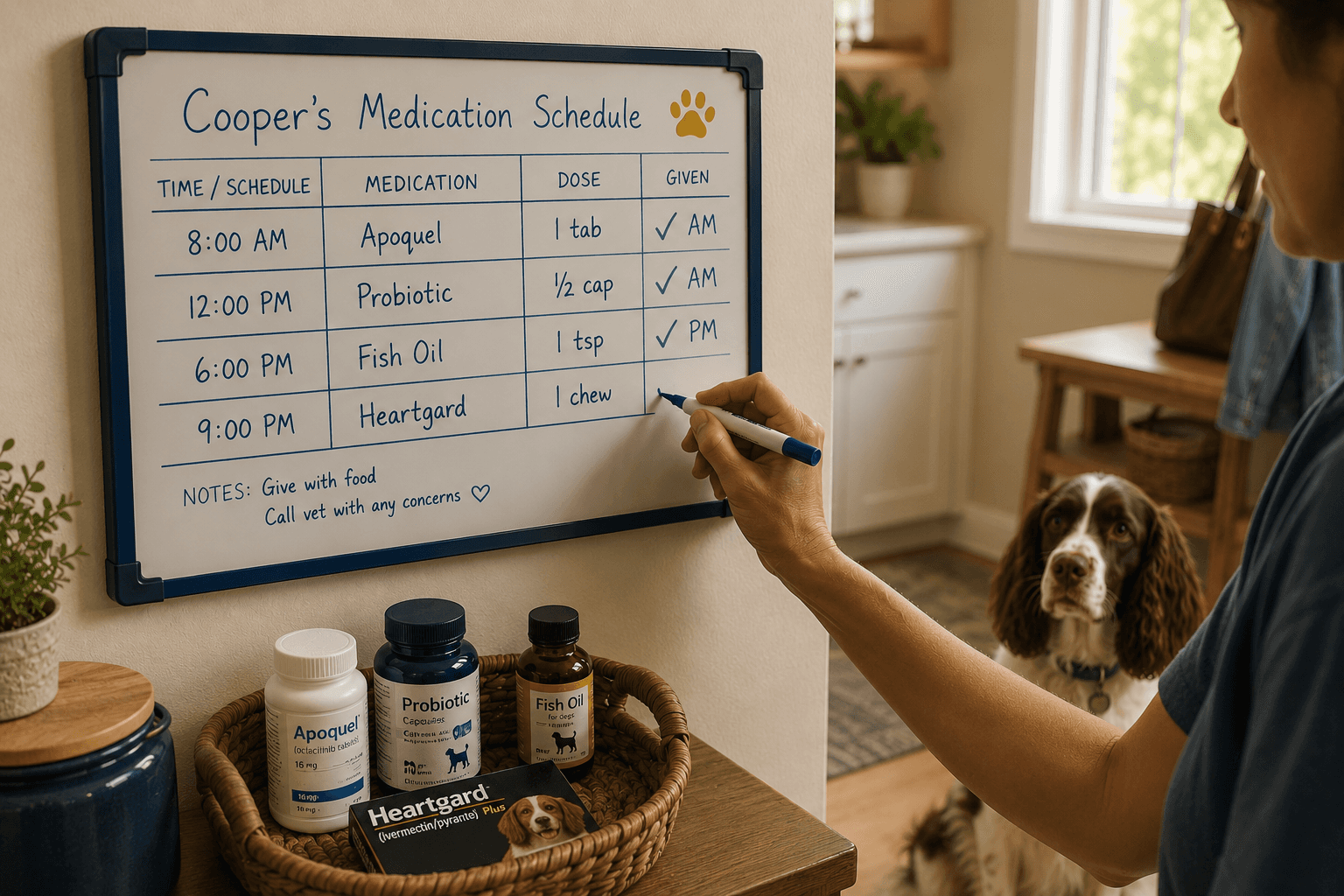
You gave the evening dose. Did your partner know that, or did they give it again an hour later? Medication mistakes rarely come from carelessness — they come from information that lived in one person's head instead of somewhere everyone could see it. A visible schedule fixes this before it becomes a problem, turning a source of daily second-guessing into something the whole household can follow without asking.
Pick One Visible Place for the Schedule
The biggest source of medication mix-ups isn't forgetfulness — it's that the schedule exists only in memory, or scattered across a phone note here and a sticky pad there. Whoever's home at dose time has to already know the plan, which works fine until it's someone who doesn't.
Choose one place everyone checks by habit: a whiteboard near the food bowls, a shared note on a family group chat, a calendar on the fridge. The format matters less than the consistency — once there's a single source of truth, "did anyone give the medication yet" stops being a question anyone has to ask out loud.
Log Each Dose the Moment It Happens
A schedule only works if it reflects reality, and reality changes the second a dose gets given. Writing "8am and 6pm" on a whiteboard tells you the plan. It doesn't tell you whether today's 8am dose actually happened.
Add a simple checkmark or initial next to each dose as it's given — not at the end of the day, but the moment it happens. This one habit prevents both directions of the problem: double-dosing because someone assumed no one had given it yet, and missed doses because everyone assumed someone else had. It takes five seconds and removes the guesswork entirely.
Write Down the Details That Don't Fit on a Whiteboard
Some information needs more room than a quick checkbox: what the medication is for, what dose, how it should be given (with food, hidden in a treat, whole pill), and what to do if a dose gets missed. This belongs in a slightly more detailed record — a shared note, a folder, whatever your household already uses for other logistics.
Keep it updated the instant anything changes, especially after a vet visit. If a dose or medication shifts, an outdated note is worse than no note — it gives whoever's filling in false confidence in the wrong information.
Make Refills Part of the Same Visible System
A medication schedule that tracks doses but not supply runs into a predictable problem: someone realizes the bottle's empty the same day a dose is due. Add the refill timeline to the same visible spot — when the current supply runs out, which pharmacy fills it, and where to find your PetRx Prescription Savings Card if it's needed at the counter.
Because the card requires no activation and no fees, it's a detail you can note once and never have to update again. Since it's accepted at more than 80,000 pharmacy locations nationwide, whoever picks up the refill — you, a partner, a family member — has a good shot at using it wherever they end up going, and can save up to 80% on the fill without any extra steps.
Build In a Way for Anyone to Check Pricing
Refill costs sometimes surprise the person filling in, especially if they're not the one who normally handles it. If your household has a habit of using Rx Price Lookup to compare pharmacy prices before filling, note that in the same visible system — which pharmacy came out ahead last time, or where to check before heading out.
This keeps cost from becoming an unexpected part of someone else's errand. Whoever's picking up the prescription can glance at the note, confirm where to go, and know the price won't be a surprise at the register.
Conclusion
A visible medication schedule isn't about adding more structure to pet care — it's about moving the plan out of one person's head and into a place the whole household can see. Log doses the moment they happen. Keep refill details and pharmacy pricing in the same spot. Make sure the PetRx Prescription Savings Card is easy to find when it's time to fill. None of this requires a complicated system, just a consistent one. Your pet is family, and the people caring for them deserve a schedule they can trust at a glance, not one they have to reconstruct from memory.